When it isn’t obvious

This past weekend, my family and I went to a pool party to celebrate a friend’s 2nd birthday. The party started late in the day – 4:30. And, as is typical during the months of August in Georgia, the day was hot and the humidity was high.

The pool provided the perfect place to find cooling comfort, assuming you wanted to be seen wearing your bathing suit in public. As for me? Yeah, no public viewings of bathing suit attire, thanks. (You’re welcome.) Thankfully, I had a friend who also chose not to share her body in a bathing suit to the viewing public. So, she and I sat, sweating, watching those around us.

One of the girls I noticed at the party seemed to socialize with folks in spurts. I chatted with her Mom briefly. Well, she chatted with me, actually. She was telling me how she would be open to having more kids, but her 45 yr old ‘well’ was dry. (Seems I’m not the only one to share too much information.) She pointed out her ‘baby’ to me, who was this boy with a body perfectly built to play a tackler in football. Come to find out, he is on the high school football team, and he is a tackler. She didn’t point out her daughter to me, though as the party came to a close, it was apparent the girl I had noticed earlier was her daughter.

Towards the end of the party, the hostess was cleaning up the leftovers. The girl asked for a cupcake, but the cupcakes had already been taken away and/or eaten. This girl, around age 12, became quite upset. She did not become the Charlie and the Chocolate Factory character, Veruca Salt, “I want a cupcake!” kind of upset; instead, she became intensely angry. Initially, I assumed her reaction was due to the intense heat and end of the day exhaustion, but I soon realized there was more to her behavior than heat and exhaustion.

As people began to leave, the girl became more and more agitated. She was screaming, throwing herself in the pool, biting her arm, running around, etc. Joe and Charlie watched her behavior, and I could tell the wheels were turning in their little heads. My friend let me know that her neighbor’s daughter was Autistic, which – of course – explained the irregular behavior.

I started gathering our things, and I let our boys know it was time for us to go. Suddenly, I noticed my oldest was starting to act out. His reaction towards me was out of character and mimicking (ever so slightly) the girl’s behavior. When we were in the car, I explained to the boys that the girl was not being bad, she was battling a disorder. But, how do you explain Autism to children? Autism is not an ‘obvious’ disorder or disability. Which got me thinking . . .

When I was in elementary school (during my 1st-3rd yrs), my Mom assisted in the Specialized Learning Development and General Learning Disability classroom. When my class was done for the day, I would spend the rest of the time waiting for my Mom in her classroom. I was exposed to special needs kids at an early age. And, whether by their walk, facial expressions or speech, their disability was obvious.

If someone strolls up to you in a wheelchair, her special need is obvious (generally speaking). If someone walks up to you with a walking stick and assisted by a K9, his special need is obvious (again, generally speaking). Sometimes, one can tell easily if another person has a special need; however, there are some disorders/disabilities that are less obvious. Autism, Aspergers, depression, manic/depression, controlled psychizophrenia, etc. How do parents explain the ‘accepted’ behavior of one child, which would be considered an ‘unaccepted’ behavior of another child?

While in the car driving home, I tried to explain to the boys that the girl was not misbehaving per se. (I didn’t actually say ‘per se’.) I tried to explain that she didn’t understand how to interact on certain levels, etc. And my oldest, who I yelled at for doing similar things he saw the girl do, said, “But Mom, she’s older than me. She should know better.” Again I ask, how does one explain behaviors of another, based on whether or not the person has special needs?

Saturday afternoon/evening proved to be interesting. My friend and I talked about situation this morning. Going back to my childhood, I don’t know that I fully understood the kids in the classroom where my Mom worked. To me, the kids were just kids who did things differently. But again, their differences were more obvious than the mental and emotional disorders faced by countless others.

Based on the reaction of my boys, they saw the girl at the pool as a ‘normal’ girl behaving ‘badly’, and their interpretation isn’t a bad thing. However, I found myself challenged on how to explain why it is “okay” for someone to behave one way, when it is not okay for another person to do the exact same thing, especially when the issue is not obvious through the eyes of a child (or the adult).
What is it about you?

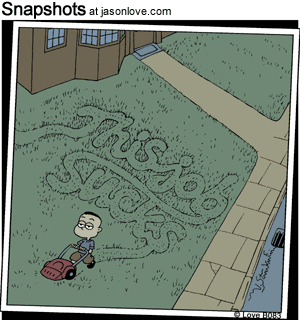
Today’s commentary is brought to you by my parents. Thanks to my parents, I have picked up many idiosyncrasies and/or obsessions. For instance, today I mowed the lawn. And, thanks to my parents, I mow the lawn in a different direction each week. This morning, I had to mow in the up/down direction (vs. side to side).

I’ve talked about mowing the lawn in previous posts. My parents always mowed the lawn in different directions. And now, I cannot bring myself to mow the lawn in the same direction every time. This obsession stinks, because we have a hill in the front yard and a hill in the backyard. I do not enjoy the days I have to mow up and down the hills; mowing side to side is much easier.

One morning, while I was mowing the lawn (up/down) our neighbor, Ed, walked by our house. Apparently, due to my red face and slow pace, he could tell I was not having an easy time. I noticed he stopped walking, so I looked over to see what he was doing. He was making a side to side motion, letting me know side to side would be easier than up/down. I stopped the mower. “I blame my parents.” I huffed. I didn’t huff because I was mad; I huffed because I was tired.

“My parents always mowed in a different direction.” I explained to Ed.

“You need to get over that.” He said.

“Well, it’s the only exercise I get. It’s not so bad.”

He smiled and said, “Join a gym.” Then he started walking again, and I started the mower and resumed my obsession.

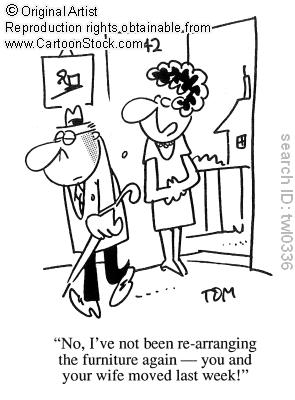
Rearranging furniture is another quirk about me that I believe comes from my parents. Well, my Dad didn’t rearrange furniture, but my Mom sure did. And, I rearrange a room in our house about once every two months. The boys have come to accept my habit of rearranging to the point that they will ask me to rearrange certain rooms. In fact, Charlie recently asked me to rearrange the kitchen. Unfortunately, the kitchen is pretty much nailed down. Aside from rearranging the counter-top, the kitchen will remain ‘as is’.

Another idiosyncrasy I possess relates to my Dad’s smoking habit, though I do not smoke. When smoking and driving, my Dad would rest his elbow on the car door, while holding a cigarette between two fingers and having the tip of his thumb in his mouth. When I am driving in the car, I catch myself in the same kind of pose my Dad had when he was smoking and driving.

Like my Dad, I also possess wrinkles around my mouth and lines on my forehead. (I realize wrinkles and facial lines aren’t considered an idiosyncrasy.) The wrinkles were more noticeable on my Dad’s Mom, as well was my Dad’s sister, though my Dad had the wrinkles, too. And, I speak in past tense, though my Dad’s sister is still very much alive. (My Dad and his Mom died 16yrs ago. *gasp!* Still seems like yesterday on some days.)

I think the wrinkles around the mouth stem from worrying. “Her pursed lips showed concern and frustration.”  Yes, my lips are in a constant state of ‘pursedness’, as I simultaneously raise my eyebrows in concern and shock, creating lines on my forehead…

Our parents pass down more than genes. They pass down habits, addictions, obsessions, idiosyncrasies, looks, etc. And no, we don’t necessarily welcome everything they pass down to us. Still, what is it about you that resembles your parents?

I feel my Dad’s presence every time I catch myself in the ‘cigarette’ pose. When I look in the mirror with pursed lips, I see my Dad in my reflection. Then I raise my eyebrows and see his same lined forehead. As I sit and scoot on my butt, dragging a dresser across the floor, I laugh to myself and wonder where my Mom would put the dresser this time. Though I may curse my parents when it comes time to mow the lawn in the up/down direction, I quite enjoy their presence in other things.

Quitting a 40-day Journey

Call me a quitter; call me weak. Regardless of what you think, I am ending my 40-day journey today, weeks before day 40. This is not to say I won’t read the rest of the books; I will continue reading, but I am no longer going to blog about my take on the readings, etc. [I can hear the applause and cheers. I’m applauding, too. I wont miss my overly dramatic (and boring) take on the messages of Warren and Tolle.]

Due to several moments last week, my viewpoints changed. Which, really, my viewpoints are in a constant state of change. I am a woman, after all.

Beatrice Potter said, “There is something delicious about writing those first few words of a story. You can never quite tell where they will take you. Mine took me here. Where I belong.”

I am here; where I belong. I don’t need to continue traveling down my self-proclaimed 40-day journey. The following thought may seem trivial, if not obvious: I was consumed with myself during this journey. And, while consumed with myself, I had friends and family suffering greater challenges in life than whether or not one eats too much ice cream. My self-centeredness seemed inappropriate and rude. (Hmmm…is it ever appropriate to be self-centered?)

I remember when my Dad died, I wanted the world to stop and acknowledge the pain and sorrow felt by my family. The reality is – death and suffering is all around us all the time. It isn’t until we feel the sting directly that we ‘get’ the grief. And, we get the triviality of self-made problems.

Am I saying we should spend each day thinking of the sorrow being felt by nameless, faceless people in the world? No. Although, I do think putting things into perspective on a daily basis is helpful. And, if that means, realizing pain and suffering surround you, so be it.

I do not like the spotlight. As much as I babble about myself and my life, you may find the previous statement hard to believe, but it is true. Instead, I want to be there for my family and friends. And, I don’t need books to find my purpose in life. My purpose in life is to help others. I thrive when I believe I am helping. Granted, times exist when I thought I was helping, but I was merely sticking my nose where it did not belong. Plus, there is a fine line between helping and nagging.

Before someone suggests that I find it easier to worry about others because I do not want to worry about or deal with my own issues, I say I do not have issues when I stop and compare my gripes to the meatier things in life. Unless I am facing a life or death situation, losing my home or loved one, going without food for an extended amount of time or some other true tragedy, well – I think I am OK. More than OK.

Do I battle depression? Yes, and I take a pill for that battle. Am I cranky sometimes? Yep, and I get happy again. Do I get overly emotional? Obviously. Do I think PMS sucks? You betchum; then, my period starts. Does my family think PMS sucks more? Yeah, and the two weeks of normalcy is never long enough. But, I am alive, and my family is healthy. I’d rather spend my time and energy allowing myself to help those who need it most. Who knows, one day it may be my family.

While it may be important to focus inward from time to time, sometimes enlightenment comes from a place outside of yourself and has nothing to do with yourself. Someone recently posted the following quote, from the Dalai Lama, on her Facebook page: “Once you shift your focus from yourself to others and extend your concern to others, this will have the immediate effect of opening up your life and helping you reach out. The practice of cultivating altruism has a beneficial effect not only from a religious point of view but also from a mundane point of view; not only for long-term spiritual development but even in terms of immediate rewards.

Amen.